
B4ker Documentation
The complete guide to using B4ker's AI agent for content creation, campaigns, and insights.
Overview
B4ker is an AI agent for marketing: it creates content, plans and optimizes campaigns, and turns metrics into decisions — always with your brand's context.
What you'll find here
- How to start from scratch and set up your first project.
- How to use Chat to plan, write, and review.
- How to run Campaigns, read Insights, and produce videos in Studio.
- How to connect integrations and automations (including Instagram).
How B4ker is organized
Everything revolves around Organization → Project. The Organization groups your team and integrations; the Project holds the context (brand, personas, assets) that B4ker uses to personalize everything it generates.
Tip: the more complete your project's context, the more specific and ready-to-use the responses become.
Getting started
1. Sign in
Log in with your email and password and complete verification/2FA if enabled. If you see a "device not trusted" notice, finish the validation so you don't get locked out.
2. Understand the Organization → Project flow
- Organization: the team's umbrella (members, permissions, and integrations).
- Project: where the work happens (knowledge, personas, assets, conversations, campaigns, and analysis).
3. Set up the project basics
Before chatting, go to Assets/Knowledge and add your product, differentiators, target audience, tone of voice, proof, and FAQs. Create or import personas so B4ker can adapt language and angles.
4. Start with Chat
Describe your goal and context (channel, deadline, offer, budget, region) and ask for clear deliverables: a calendar, creative ideas, scripts, copy, and per-platform variations.
5. Put it into action
- Campaigns: turn content into actions.
- Insights: track metrics and find what to adjust.
- Integrations: connect data sources to automate reports.
If something feels off-context, confirm you're in the right Project — B4ker personalizes everything based on it.
Organizations and projects
Organizations
Separate teams/companies and centralize settings (members, permissions, integrations, and governance). Create another Organization when you need to isolate data and access for different clients or businesses.
Projects
They organize work by brand, unit, product, or client — and define B4ker's context. Good structures:
- 1 project per brand/client;
- by unit (e.g., "SP Store", "RJ Store");
- by goal (e.g., "Acquisition", "Retention") when audiences and assets change a lot.
Checklist to create a project
- Name it clearly (brand + goal/channel).
- Add the minimum context in Assets/Knowledge: positioning, offer, differentiators, proof, restrictions, and links.
- Register personas/ICP and examples of "good" content.
Day-to-day management
- Switch projects when changing client/brand before creating conversations or campaigns.
- Update the context when product, price, branding, or goal changes.
- If a theme grows too big, create a new project to keep history and analysis clean.
Permissions
Use Organization members and roles to control who can view and edit projects, integrations, and billing. If someone can't find a project, it's almost always a permission issue or the wrong Organization.
Chat (AI agent)
Chat is your copilot to plan, write, and optimize marketing with the project's context.
What you can do
- Plan: goal, value proposition, angles, calendar, and funnel.
- Research and brainstorm: themes, hooks, headlines, offers, and per-audience variations.
- Produce: copy (ad, email, landing page, WhatsApp), scripts (Reels/TikTok/YouTube), and creative briefs.
- Review: clarity, tone of voice, brand consistency, and A/B versions.
- Operationalize: turn a brief into a campaign structure.
How to ask for ready-to-use output
- Always include: goal, channel, audience, offer, region/language, budget, and deadline.
- Define the final format: "10 variations", "table with Headline/Text/CTA", "script with scenes and lines".
- For top quality, ask B4ker to ask you questions before generating.
Generic answers almost always mean missing context (Knowledge/Personas) or not specifying channel, goal, and constraints.
Campaigns
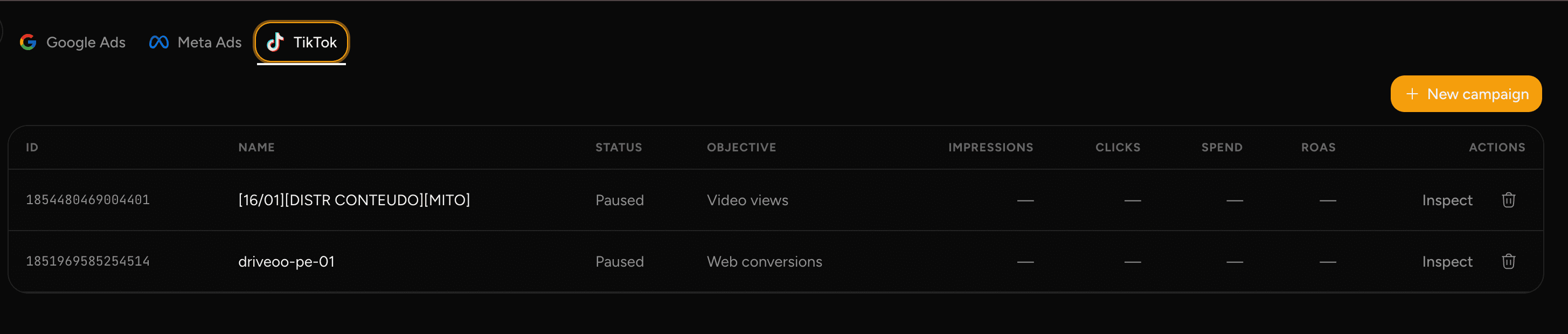
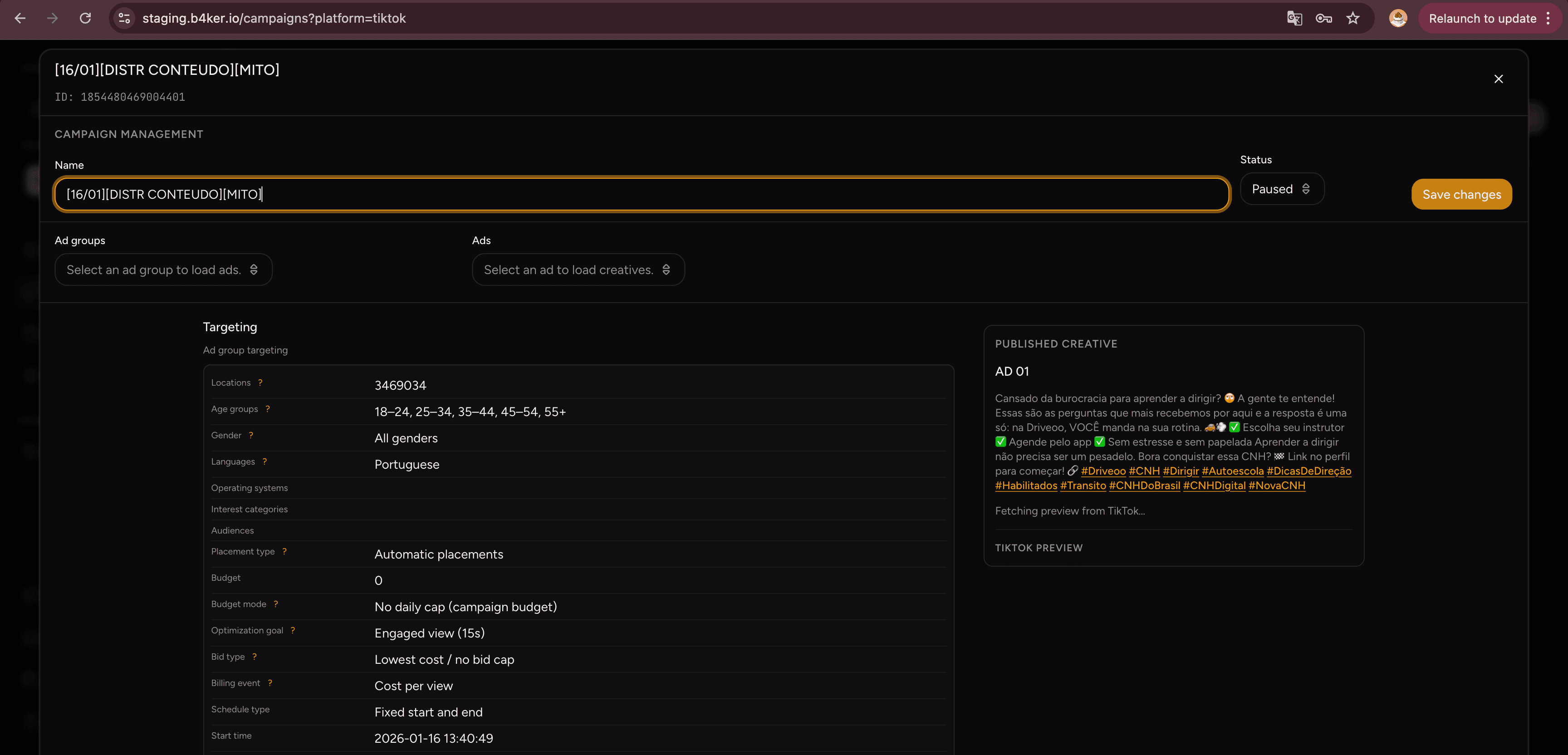
Plan, run, and optimize connected campaigns (Google, Meta, and TikTok) with B4ker's help.
What you can do
- Plan: goal, structure (campaign → ad sets → ads), budget, audience, and KPIs.
- Manage: create, pause/resume, adjust budget, and review performance per project.
- Optimize: spot what works and prioritize creative, targeting, and message tests.
Recommended flow with Chat
- Brief → strategy: "Build a strategy for [goal] with [budget] on channel [X]."
- Structure → test plan: "Create an A/B plan with 3 angles and 5 copy variations each."
- Ready-made creatives: "Generate 10 complete ads (headline, text, description, CTA) for Meta."
- Run with data: bring CPC, CTR, CPA, and ROAS and ask "what to pause, duplicate, and test".
Keep campaigns and conversations in the right project — it organizes history and improves recommendations over time.
Insights
Insights is your reading and decision panel: it brings together campaign metrics along with context (channel, goal, audience, and creatives).
Recommended flow
- Start with the goal: lower CPA? raise ROAS? improve CTR? scale?
- Filter before concluding: period (e.g., last 7 days vs. previous 7), channel/account/campaign, and status.
- Read from macro to micro: overview → by campaign → by ad set/ad.
Interpret with context
- Low CTR + high CPM: a creative, message, or audience problem.
- High CPC: weak creative or expensive targeting.
- High CPA with good CTR: a bottleneck on the landing page or the offer.
- High frequency: saturation — you need new variations.
Turn reading into action
- Pause: high spend and performance below target.
- Scale: CPA/ROAS on target and stable.
- Test: new angles, offers, and variations.
Use Chat alongside: paste the numbers and ask "diagnose this and give me 5 priority actions + 3 tests for next week".
Studio
Studio is the production module: build, edit, and version videos with speed and brand consistency.
What you can do
- Build videos scene by scene (hook → benefit → proof → CTA).
- Edit on the timeline: cuts, duration, order, and pacing.
- Reuse project assets and keep the brand standard.
- Create variations by channel (Reels/TikTok/Shorts), offer, and audience.
Recommended flow
- Script: use Chat to generate 3 scripts (15s/30s) in the brand's tone.
- Scenes: break it into short scenes with text, voice, and visual direction.
- First version: build a quick draft prioritizing pacing and clarity.
- Variations: change one thing at a time (hook, first line, CTA) and name them to compare later.
- Final review: mobile legibility, tone, allowed claims, CTA, and duration per channel.
Use Insights to find what to improve (CTR, retention) and go back to Studio to produce the next variations based on the data.
Assets and Knowledge
Assets and Knowledge is the most important part for Chat quality: this is where B4ker pulls the context to create with your brand's voice.
What goes into Knowledge
- Brand and positioning: what you sell, to whom, differentiators, promise, tone of voice, and what you're "not".
- Offer and rules: prices, conditions, regions, deadlines, guarantees, and restrictions (forbidden claims, compliance).
- Proof: cases, testimonials, allowed numbers, awards, and certifications.
- Product: features, benefits, common objections, and approved responses.
- References: landing pages, social channels, competitors, and examples of "good" and "bad".
How to organize it
- Think of it as a brand guide: short, objective, reusable information.
- Split it by topics (Offer, Audience, Tone of voice, Proof, Objections, FAQ).
- Update it whenever price, promise, branding, or audience changes.
Quick setup
- Add the essentials (15–30 min): business, ICP/personas, offer, tone of voice, and 5 objections with answers.
- Add 3–10 strong proof points and 5 examples of creatives that performed.
- Keep the base alive: after each campaign, save winning angles and lessons.
The more complete and up-to-date the Knowledge Base, the more consistent and campaign-ready the responses.
Personas
Personas describe who you're talking to. With them, B4ker adapts language, angles, and objections to each audience.
How to build a good persona
- Who they are: role/profile, context, age range, and channels they use.
- Pains and desires: the problem it solves and the result they want.
- Objections: why they'd hesitate to buy — and the answer to each one.
- Language: tone, slang, and terms that connect (and the ones that don't).
How to use them day to day
- Select the persona when asking for content: "write for [persona]".
- Create variations of the same campaign per persona to test angles.
- Review personas when offer, price, or audience changes.
Clear personas + complete Knowledge = far more specific creatives with higher conversion.
Content calendar
The Calendar organizes what will be published and when, giving rhythm and an overall view to your content production.
What you can do
- Plan publications by date, channel, and goal.
- Visualize the week/month cadence and avoid gaps or overload.
- Connect the calendar to what you generate in Chat and produce in Studio.
Recommended flow
- Define your content pillars (e.g., educate, prove, convert).
- Use Chat to generate an editorial calendar with themes per day.
- Distribute formats by channel (Reels, carousel, stories, ad).
- Track and adjust based on Insights.
Planning in batches (one production window per week) keeps consistency and reduces rework.
Leads
The Leads section gathers the contacts captured by your Meta lead generation forms (LeadGen), ready for follow-up.
What you'll find
- A list of leads by campaign/form, with the submitted data.
- The source of each lead (campaign, ad set, and ad).
- Follow-up so you don't miss opportunities.
Best practices
- Respond fast: conversion odds drop over time.
- Connect the Meta integration with read permission so leads show up here.
- Use Chat to generate first-contact messages in the brand's tone.
Empty leads? Check the right project/account, the filters, and whether the Meta integration has permission to read forms.
Settings and integrations
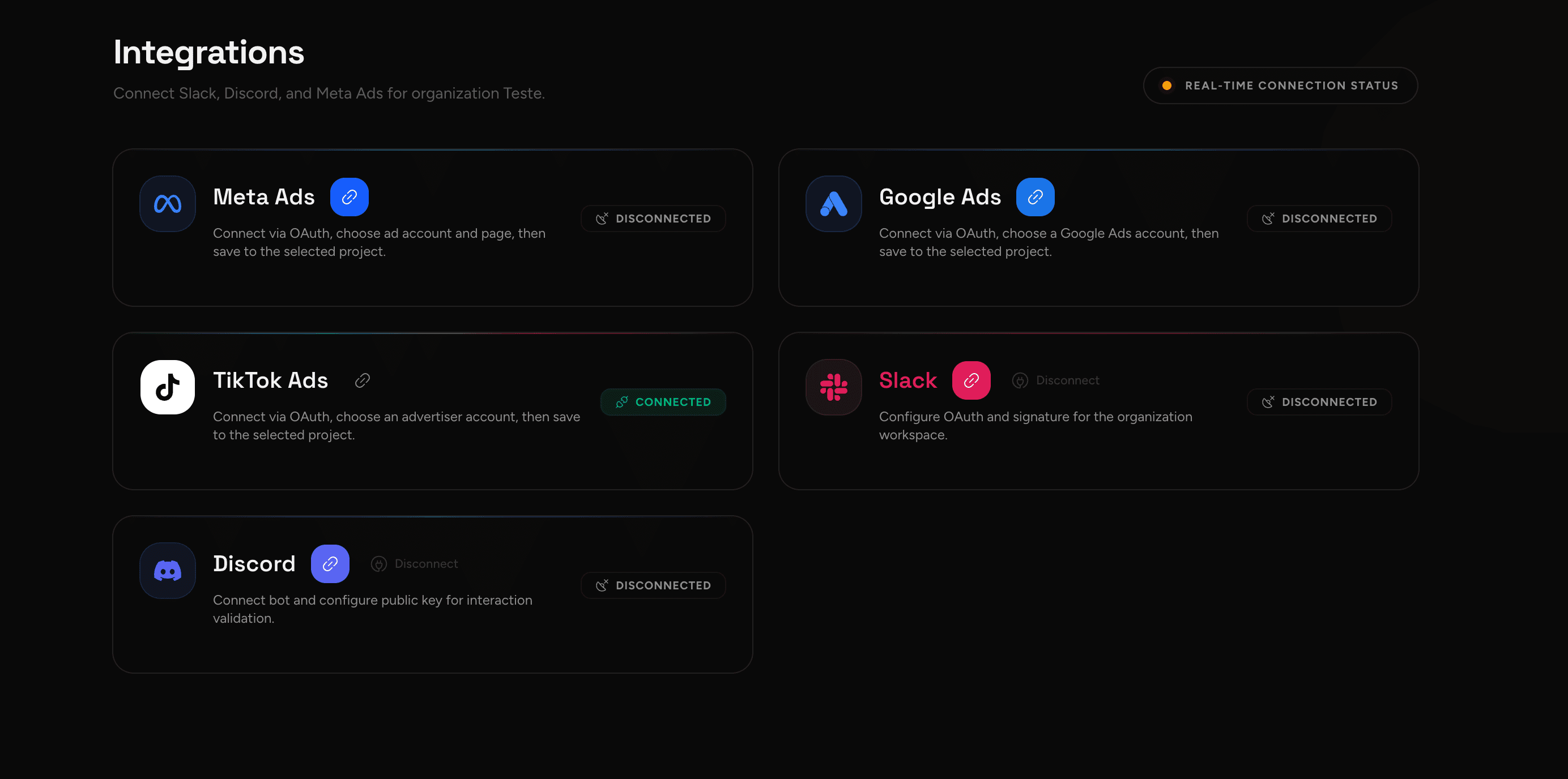
This is where you define how B4ker connects to your world: integrations, preferences, and security.
What to connect
- Ad platforms (Meta, Google, TikTok): they pull campaigns and metrics that feed Insights and optimizations.
- Channels and tools (Slack, Discord, webhooks): they receive reports, alerts, and operational messages.
Setup flow
- Connect the main data source (where your campaigns run).
- Validate: check the right account, read permissions (and action permissions, when applicable), and that data appears in Campaigns/Insights.
- Automate communication (optional): set where the team receives updates.
- Review security: keep trusted devices and access up to date.
Best practices
- Connect integrations per Organization (governance) and separate context per Project.
- If something "doesn't show up", it's almost always the wrong project/account, insufficient permission, or a filter.
The better your integrations, the stronger the loop Campaigns → Insights → Chat → new variations.
Instagram and auto-reply
Connect Instagram and turn on auto-reply for comments and messages (organic engagement automation). Replies come out in the brand's tone, based on the project's knowledge base. This automation does not run ads or boosting.
Prerequisites
- A professional Instagram account (Business or Creator) — personal accounts don't grant the required permissions.
- Admin permission to manage integrations in the project.
- A filled-in project knowledge base (it's what gives quality to the replies).
1. Connect Instagram
Go to Settings → Integrations and find the Instagram card (Meta group). Click Connect and grant all permissions — especially manage comments and manage messages (required). When you return, the card shows Connected with your @username. If you decline any permission, click Reconnect and authorize everything.
2. Allow third-party tools (in the Instagram app)
In the app: Settings → Messages (or Privacy/Message controls) and enable access for connected/third-party tools to messages. The name varies by app version.
3. Enable auto-reply
Open the Engagement automation card and turn on the Automation enabled switch. Choose the Review mode:
- Automatic: sends on its own after the safety check.
- Human review: the reply goes to the Approval queue for you to approve/edit before sending (recommended to start).
In Active channels, choose: public reply (on the comment), private reply (in the commenter's direct), and direct message (DM auto-reply). Optional: list excluded posts (opt-out) and configure the automation disclosure.
4. Validate
- After turning it on, the card shows Awaiting test with the Test connection button.
- Click Test connection and comment on a recent post on the account itself. The card switches to Verifying… and waits for the webhook to arrive (a few seconds).
- When the first comment arrives, the card turns Active.
- In Human review, the reply appears in the Approval queue; in Automatic, it's sent on its own.
What to expect
- New comments trigger a reply through the active channels; DMs are answered within the allowed window.
- Meta's rules are respected: no proactive DMs, one reply per comment, and sending only within the windows. Opt-out posts never receive a reply.
- Privacy: B4ker uses only the data needed to reply and audit.
Note on App Review / production
Serving third-party accounts in production requires Meta approval (App Review + Business Verification, and Tech Provider for multi-account). While the app isn't approved, the automation only works for test/developer accounts with a role on the app.
Billing and Wallet
Billing and Wallet is where you control costs and ensure continuity of use.
Concepts
- Credits/balance: B4ker's "fuel" (chat, generation, and automations).
- Usage: how much was used per period (and, when available, per module/project).
- Limits: predictability to avoid interruptions in the middle of a campaign.
How to keep track
- Review balance and usage weekly (or daily during intense campaigns).
- Use history to understand spikes (launches, many tests, high-volume generation).
To avoid running out of balance
- Plan production windows: generate in batches, then refine.
- Standardize prompts and briefs in Knowledge to reduce rework.
If something stops working, check balance/limit first; then integrations and permissions.
Frequently asked questions
Straight answers to the most common questions about B4ker.
What is B4ker and what makes it different?
B4ker is an AI marketing platform that brings content creation, paid campaigns, organic publishing, and analytics together in one place. The difference is the agent: it knows your brand's context (Knowledge, personas, assets, history) and executes end to end. You chat, it creates the creative, builds the campaign, publishes, and tracks the results.
How does AI campaign creation work?
You describe your goal in Chat and B4ker's strategist builds a complete plan: campaign structure, audience, budget, creatives, and a hypothesis of what should work. Nothing goes live without your approval: you review, adjust whatever you want, and only then is the campaign created on the ad platform. Afterwards, B4ker compares the real result against the hypothesis and uses that learning in future campaigns.
Which ad platforms are supported?
Meta Ads (Facebook and Instagram), Google Ads, and TikTok Ads. You connect your accounts in Settings → Integrations and manage everything from the same interface: creation, pausing, budget adjustments, and metrics.
Does B4ker also publish organic content?
Yes. Beyond ads, B4ker generates and publishes organic content (such as Instagram posts), organizes production in the Calendar, and can reply to comments and messages automatically with auto-reply, always in your brand's tone and with optional human review.
What is the Studio?
The Studio is the AI video production module. You generate videos from a Chat request or a script, edit on the timeline (cuts, order, pacing), reuse project assets, and create variations per channel and audience (Reels, TikTok, Shorts).
How do credits, wallet, and plans work?
Credits are the platform's fuel: content generation, videos, and automations consume credits from your balance. Each plan includes a monthly credit budget, plus limits on projects, seats, and storage. You track balance and usage in the Wallet and can switch plans whenever you want.
Do I need to connect my own ad accounts?
Yes. Campaigns run on your own Meta, Google, and TikTok accounts, so the media spend and history remain yours. The connection uses each platform's official authorization, credentials are stored encrypted in a secure vault, and you can revoke access at any time.
What are Organizations and Projects?
The Organization is the team or company level: members, permissions, integrations, and billing. The Project lives inside the Organization and holds the context of one brand or client: knowledge, personas, assets, conversations, and campaigns. Agencies usually create one project per client; B4ker personalizes everything based on the active project.
Which integrations are available?
Ad platforms (Meta, Google, TikTok), Instagram for publishing and auto-reply, and channels like Slack, Discord, and webhooks for reports and alerts. B4ker also supports MCP (Model Context Protocol), which lets you connect the agent to compatible external tools.
How is my data handled?
Your project data (knowledge, assets, metrics) is used only to personalize what B4ker generates for you and stays isolated per Organization. Credentials are encrypted, access is controlled by permissions, and you can request an export or deletion of your data. Details are in the Privacy Policy.
Is there a trial? How do I cancel?
You can start on the free plan and try the platform with no commitment before subscribing. To cancel a paid plan, go to Settings → Billing; access continues until the end of the period you already paid for, with no penalty.
How do I contact support?
Write to support@b4ker.io, including for technical API and integration matters. Before opening a ticket, check the basics: the right active project, applied filters, and integration permissions.